Hyperliquid has attained a new all-time high (ATH), but this time in open trading positions. Per on-chain data, the open positions soared above 275,000 within the past 24 hours. Notably, the rally comes as the broader crypto market is experiencing a slight setback.
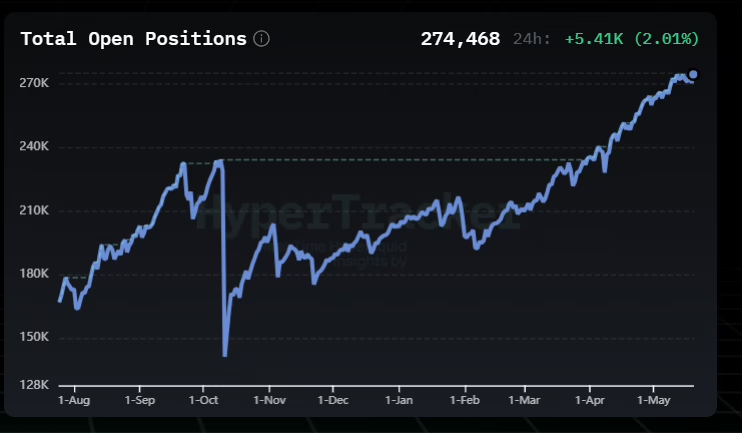
In the crypto world, open positions refer to trades that are still active and have not yet been closed. For instance, if a trader buys a digital asset expecting the price to rise and decides to keep the trade open, it’s typically called an open position.
The latest ATH in Hyperliquid’s open positions coincides with a surge in open interest (OI), a metric showing all active and unsettled trades. Hyperliquid recently announced that the OI in RWA trading reached a peak of $2.6 billion, double its level two months ago. The platform noted that market demand for onchain access to RWA also continues to increase.
Hyperliquid’s Volume Drops: Bullish or Bearish?
Despite Hyperliquid’s recent ATH, a closer look at on-chain data reveals that trading volume has dropped by over 20%. It moved from over $5.34 billion to approximately $4.35 billion over the past 24 hours.
This could imply that traders are not exiting positions but are instead holding exposure with less trading activity. On the bright side, this typically suggests increased position conviction, reduced short-term speculation, and potential buildup ahead of a directional move.
HYPE’s Market Performance
Amid various activities within its ecosystem, Hyperliquid’s HYPE has emerged as one of the top gainers in the crypto market. It currently trades at $47.79, up 6.3% over the last 24 hours.
A recent analysis revealed that with support from firms such as Bitwise and a16z, HYPE may finally be on its way to the $50 threshold.
Meanwhile, there exist concerns that HYPE may be on track for a massive token unlock, scheduled for June 6th. Per CoinTab’s recent analysis, the market could see 9.9 million HYPE tokens distributed to core contributors. If this happens, it would mean $449.3 million in HYPE would be circulated, which could dilute the supply and, by extension, the token’s price.








 Ephraim Emmanuel | May 18, 2026


 Mishael Nwani | May 15, 2026